
Citation Recommendations
for NIAID Repositories
Clear citation guidance helps researchers cite data correctly, know what attribution is required, and understand the context of what they're citing. These five recommendations build on the NIAID Blueprint (Version 2), released by NIAID's Office of Data Science and Emerging Technologies in 2025.
There are five broad recommendations:
Open a recommendation for key practices and repository examples.
1
Use persistent identifiers (PIDs)
Give data resources identifiers that reliably point to them over time.
Why it matters
PIDs enable discrete identification of the data that people used to produce scientific findings, and provide a mechanism to directly link to the location where the data can be found.
Key practices
-
Persistence: Choose PIDs with secure organizational backing, effective governance, and a sound technical base.
-
Services: Use PID systems that offer useful services, such as APIs for creating and querying PIDs and web services that expose PID metadata.
-
Useful information: Ensure PIDs resolve to a landing page that provides access to the resource and additional metadata about it.
-
PID types: See the Blueprint for which PID types are recommended for specific entities.
Example 1.1
ImmPort Repository - https://doi.org/10.21430/M3VF5F8ANE

ImmPort assigns a DOI to each public study, including study https://www.immport.org/shared/study/SDY1109.
2
Display a recommended citation
Make it easy for data users to find and use the correct citation.
Why it matters
Data users may not know how to cite your data resources, so make the recommended citation easy to find and use.
Key practices
-
Be clear: State how you want people to cite your data, whether as the whole collection or the specific part or set they used.
-
Make it easy to copy: Let users copy and paste the citation or import it into a citation management system, so it’s cited more consistently and fits their usual workflows.
-
Include PIDs: Add PIDs to recommended citations. They give citation services a consistent way to track how your resource is used, even when authors or journals change other citation details.
Helpful tools
The Basics of Data Citation provide guidance on how to structure recommended data citations. Additionally, tools like the DOI Citation Formatter provide identifiers (DOI) for citation mapping for many hundreds of citation styles.
Example 2.1
Dryad Data Repository – https://doi.org/10.5061/dryad.qn8n3

Each dataset shows a recommended citation, including its DOI, at the top right of the page, with a “copy” button for easy pasting.
3
Integrate with citation management tools
Let users import citation metadata directly into the tools they already use.
Why it matters
Many researchers use citation management tools to collect citations and generate bibliographies for their publications.
Key practices
Helpful tools
The Basics of Data Citation provide guidance on how to structure recommended data citations. Additionally, tools like the DOI Citation Formatter provide identifiers (DOI) for citation mapping for many hundreds of citation styles.
Example 3.1
Johns Hopkins Research Data Repository – https://doi.org/10.7281/T17P8W98

Alongside the recommended citation, users can download citation metadata in formats including EndNote, BibTeX, and RIS.
Example 3.2
NIRD Research Data Archive, Norway – https://doi.org/10.11582/2020.00060

Each dataset page has a “Citation” tab with the recommended citation and downloads in BibTeX, RIS, and other formats.
4
Connect related resources
Link datasets to related resources through metadata and PIDs.
Why it matters
Where possible, PID metadata and landing pages should reference related resources to support data discovery and provenance.
Key practices
-
On landing pages: List other relevant resources, including their PIDs.
-
In PID metadata: Use fields that link related PIDs, such as the “RelatedItem” field in the DataCite DOI metadata schema. RRID metadata can also list related resources.
-
What to cross-link: Data, software, instrumentation and materials, research resources (e.g., cell lines, antibodies, reagents), publications, people, organizations, and experiments, protocols, or trials.
Example 4.1
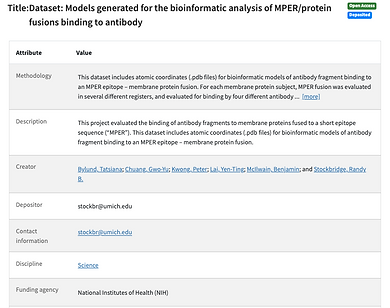
University of Michigan Deep Blue Data Repository – https://doi.org/10.7302/7ym7-gp78
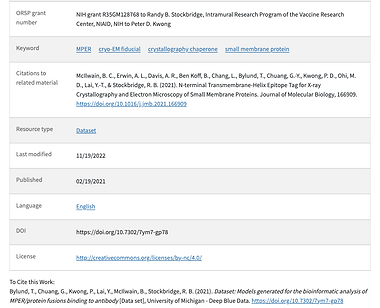
Each dataset page shows a recommended citation at the bottom, along with any related papers.
Example 4.2
The DataCite DOI metadata for the same dataset links it to the related paper through an “isReferencedBy” relationship. “HasPart” relationships show that the dataset has two distinct components. DataCite supports many additional relationship types that may be useful for data users.
5
Measure citations and PID use
Track how data is cited to understand and demonstrate impact.
Why it matters
PIDs link back to original resources and make it possible to trace their impact. As repositories improve their FAIR practices, they also improve their ability to measure that impact.
Key practices
-
Measure at two levels: Track how often specific resources are cited (PID level) and how many of a repository’s PIDs are cited overall (repository level).
-
Inform decisions: Use citation metrics to guide operational choices, such as identifying less-used datasets that could move to lower-cost storage.
-
Compare with other metrics: Look at citations alongside page views and downloads. Differences can reveal usability challenges or different audiences, such as datasets used more for teaching than research.
-
Support researchers: PID-based citations are easy to add to CVs and profiles like ORCID.
Example 5.1
NSF NCAR Geoscience Data Exchange (GDEX) – https://doi.org/10.5065/BH6N-5N20 – A “Citation” tab lets users pick a citation style, copy it, or download the metadata. GDEX also shows each dataset’s citation count and the citing works, gathered automatically by searching citation indexes such as Crossref (free), Scopus, and Web of Science (both paid) for the dataset’s DOI.
