


Mark Musen: Building the Foundation for FAIR Data
Every day, scientists generate enormous amounts of research data. But once a study is published, another challenge begins. Can another researcher find that data? Will they understand how it was collected? Can they combine it with other datasets years later? For decades, Stanford University professor Mark Musen has worked on answering those questions. Rather than studying a single disease or developing a single treatment, he has focused on building the tools that help researchers organize, describe and share scientific data so it remains useful long after an experiment ends.
Musen began his career in medicine before moving into biomedical informatics, a field that brings together medicine, computer science and data science. As biomedical research became increasingly digital, he recognized a growing problem. Scientists were producing more data than ever before, but much of it was difficult to interpret or reuse because every laboratory described its work differently. The data existed, but without enough context, it was often unusable by other researchers.
That challenge shaped much of his career.
Over the past several decades, Musen has helped build many of the tools that support modern biomedical data sharing. His research group developed Protégé, now the world's most widely used platform for creating ontologies, or structured vocabularies that allow both people and computers to interpret scientific concepts consistently. He also led the National Center for Biomedical Ontology (NCBO), which in 2005 created BioPortal, an online repository that gives researchers access to hundreds of biomedical ontologies used around the world.
“Well formed metadata that is grounded in ontologies and community standards form the backbone of data sharing,” Noy said. “NCBO and BioPortal play a critical role in building this backbone and in making sure the metadata is useful.”
While the FAIR principles (findability, accessibility, interoperability and reusability) are straightforward, putting them into practice can be difficult for researchers who are already managing complex experiments. The original FAIR paper deliberately outlined high-level goals rather than prescribing specific technologies. Musen's response was to simplify the process rather than add more rules.
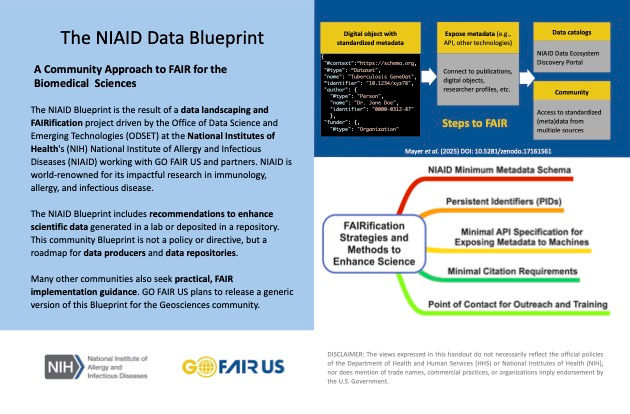
In 2014, he founded the Center for Expanded Data Annotation and Retrieval (CEDAR), which helps researchers create standardized metadata, or information that describes a dataset. Instead of asking scientists to remember dozens of FAIR recommendations, CEDAR provides community-developed templates that guide researchers through describing their work. As Musen has written, these metadata templates help "demystify" FAIR by turning broad principles into something researchers can use as part of their normal workflow.
“Although CEDAR helps investigators to improve the quality of their metadata going forward, most of the world’s metadata already exist—and most of the metadata are terrible!” Musen said when interviewed for this article. “As large language models become more common in research, our team has been investigating whether AI can improve the quality of ‘legacy’ metadata to enhance existing datasets.”
Musen said that his team's findings suggest that AI performs far better when it works alongside structured knowledge bases like CEDAR than when it operates alone. Rather than replacing community standards, AI becomes more reliable when those standards already exist.
Today, Musen serves on the Executive Committee of CODATA while continuing to lead research at Stanford. Throughout his career, his message has remained remarkably consistent. Better science depends not only on generating new data, but also on making that data understandable, reusable and available to others. That requires more than technology. It requires shared standards, practical tools and a scientific community willing to invest in the long-term value of its data.
As research becomes increasingly driven by data and artificial intelligence, the need for well-organized, reusable information will only continue to grow. Through tools like Protégé, BioPortal and CEDAR, Mark Musen has spent decades building the foundation that helps researchers around the world turn data into discovery.
Funding Acknowledgement
We gratefully acknowledge the Office of Data Science and Emerging Technologies (ODSET) at the National Institute of Allergy and Infectious Diseases (NIAID).This project has been funded in whole or in part with Federal funds from the NIAID, National Institutes of Health, under Contract No. 75N91019D00024, Task Order No. 75N91020F0022. Any opinions, findings, and conclusions or recommendations expressed in this material are those of the author(s) and do not necessarily reflect the views of the Frederick National Laboratory for Cancer Research, Leidos Biomedical Research, Inc., or NIAID. Any opinions, findings, and conclusions or recommendations expressed in this material are those of the author(s).


Comments